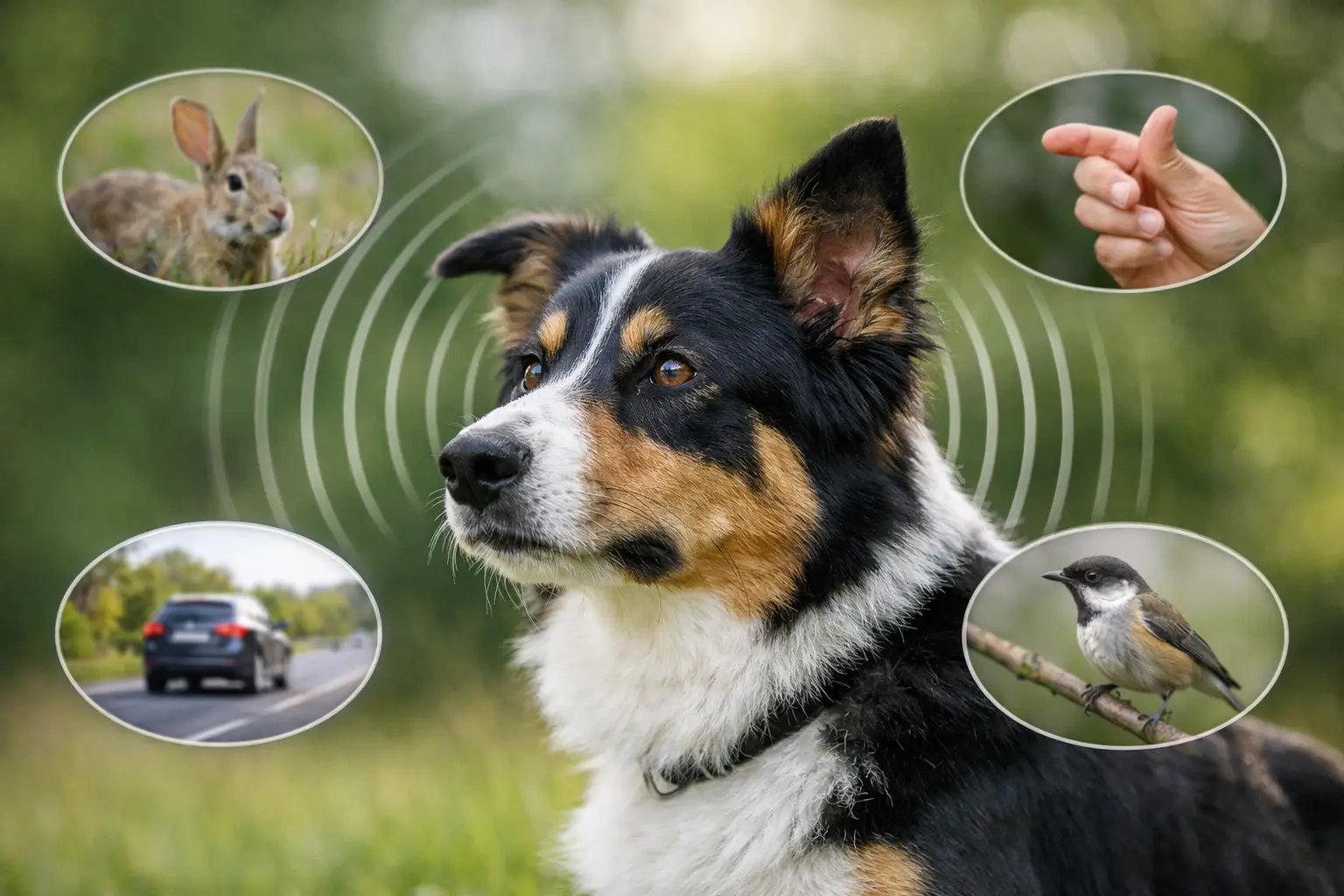
Dog Hearing Range and What Your Dog Really Hears

The refrigerator clicks on, a delivery truck brakes two houses away, and your dog lifts their head before you have noticed a thing. Dog hearing range is wider than ours in the higher frequencies, but that does not mean dogs hear every sound better or that they should simply “get used to” stressful noise. What your dog hears, how they feel about it, and what happens next can all shape behavior.
For families sharing apartments, busy Dallas sidewalks, school pickup lines, patios, and lively homes, sound is part of daily dog life. Understanding it can replace frustration with a more useful question: what is my dog telling me about this environment?
Dog Hearing Range: Higher Pitches, Different Details
A healthy human ear generally hears frequencies from about 20 hertz to 20,000 hertz, although our upper range commonly decreases with age. Dogs are often able to detect sounds from roughly 67 hertz up to 45,000 hertz or higher. The exact dog hearing range varies with age, breed, individual health, and the sound itself.
That upper range is why a dog may notice the high electronic whine of a charger, tiny rodent movement in a wall, or a distant dog tag jingle that does not register for you. Dogs can also use their mobile outer ears to help locate a sound. Those alert, swiveling ears are not always a sign that something is wrong. They are often gathering information.
Still, “dogs hear better” is an oversimplification. Humans may be more sensitive to certain lower-frequency sounds. A sound’s volume, pitch, distance, duration, and whether it arrives suddenly all matter. Your dog may sleep through a thunderstorm but leap up at the beep of a smoke detector battery. Behavior is information, not proof that your dog is being dramatic or difficult.
Hearing Is Only Part of the Picture
Two dogs can hear the same doorbell and have completely different responses. One trots over, tail wagging, because the bell predicts familiar visitors. Another barks, races to the window, or hides because the sound predicts uncertainty, an interrupted nap, or strangers entering their space.
The sound is the trigger, but learning history and current emotional state shape the reaction. A puppy who is tired after a big day of puppy training, a dog already worried by traffic on a White Rock Lake walk, or a dog with big feelings around guests may have less room to cope with one more noise. This is why effective support looks at both ends of the leash and the whole situation, not just the barking.
Why Everyday Noises Can Feel So Big
Many household sounds are brief for us but sharp, unpredictable, or difficult to escape for dogs. Vacuum cleaners, blenders, construction, fireworks, children’s toys, sirens, and metal food bowls can all be challenging. In compact homes and apartments, sound may bounce off hard floors and walls, making it feel closer or more intense.
Some dogs become sound-sensitive after a frightening experience. Others are naturally more cautious, are in a developmental fear period, or have had little gentle exposure to normal life sounds. Pain can lower a dog’s tolerance too. A dog with an ear infection, dental discomfort, arthritis, or another medical concern may be less patient when startled or touched.
A dog who barks at every passing truck is not trying to give you a hard time. They may be trying to create distance, release nervous energy, or communicate that they do not feel safe enough to learn. Punishing that response can make the noise predict an even worse experience. Your dog does not need to be scared to learn.
Listening for Signs of Sound Stress
Not every sound-sensitive dog barks. Some freeze, leave the room, pant, pace, lick their lips, scan the windows, cling to a person, refuse food, or suddenly become unable to respond to familiar cues. Others become silly, mouthy, zoomy, or extra reactive on leash. Arousal does not always look like fear, but it can still mean a dog is over their coping threshold.
Watch for patterns instead of judging one moment in isolation. Does your dog struggle only when the garbage truck comes by? Is the response worse after dark, when guests are present, or when they have already had a busy day? A short note on your phone can help you see what is predictable.
If your dog seems to have sudden hearing loss, ear pain, balance changes, head shaking, odor or discharge from the ears, or a dramatic new reaction to sound, contact your veterinarian. Training can support emotional comfort, but medical care comes first when pain or a sensory change may be involved.
Use Sound Awareness in Force-Free Training
Sound is a training tool only when your dog is comfortable enough to process it. Saying a cue louder does not make it clearer. Repeating “come” over and over while your dog is locked onto a loud lawn mower can teach them that the word is background noise.
Start where your dog can succeed. If street noise makes loose-leash practice hard, begin in a quiet hallway, yard, or calm corner of the park. Reinforce check-ins, easy turns, and relaxed sniffing before asking for those skills near a busy road. Then increase difficulty gradually. Positive reinforcement dog training Dallas families can use in real life is not permissive. It includes management, boundaries, safety, practice, and thoughtful setup.
For a dog worried by a particular sound, pair a very low, tolerable version of that sound with something they enjoy, such as tiny treats, a scatter of kibble, or a favorite game. Keep the volume low enough that your dog can remain loose-bodied and choose to eat. If they stop taking food, stare, bark, or try to leave, the session was too hard. Lower the volume, add distance, shorten the exposure, or stop for the day.
You do not need to force your dog to sit beside a vacuum, endure a crowded patio, or remain outside during fireworks to prove they can cope. That approach can overwhelm rather than build confidence. A quieter room, closed curtains, a fan or white noise, a stuffed food toy, and a cozy retreat can be smart management. Management is not failure. It protects your dog while new skills are still growing.
Choose Cues Your Dog Can Reliably Notice
Dogs can miss verbal cues when they are sleeping, facing away, distracted, or experiencing hearing changes. Pairing words with clear hand signals is helpful for every dog, not only deaf or hard-of-hearing dogs. A visual “come,” a hand target, or a gentle light flicker in another room can give your dog more than one way to understand you.
Avoid startling a sleeping dog with a sudden touch, especially if they are older or have reduced hearing. Walk nearby first, make a light floor vibration if appropriate, or toss a treat close enough for the scent to wake them. When you must touch them, do it gently and predictably, then follow with something pleasant. This creates trust around being awakened rather than a reason to startle.
Hearing Changes as Dogs Age
Senior dogs may gradually lose the ability to hear high-pitched sounds first. You may notice that your dog no longer wakes for a familiar sound, seems slower to respond outdoors, or startles when approached from behind. These changes can be confusing for a dog and for the people who love them.
Adapt the environment instead of assuming your dog is ignoring you. Use visual cues, predictable routines, safe enclosed areas, and a long line when appropriate outdoors. Let family members, especially children, know how to approach gently. A dog who cannot hear someone coming may need more space and clearer communication, not correction.
Whether your dog hears a leaf rustle from across the yard or sleeps through the doorbell, their behavior around sound deserves curiosity. When we listen to what they are communicating, we can make home feel more predictable and help them build confidence at a pace that is kind.
If noise, barking, startle responses, or big feelings are making daily life harder, Wiggle Butt Academy is here to help. Schedule a free phone consultation to talk through your dog’s needs and find a calm, practical next step together.


Comments