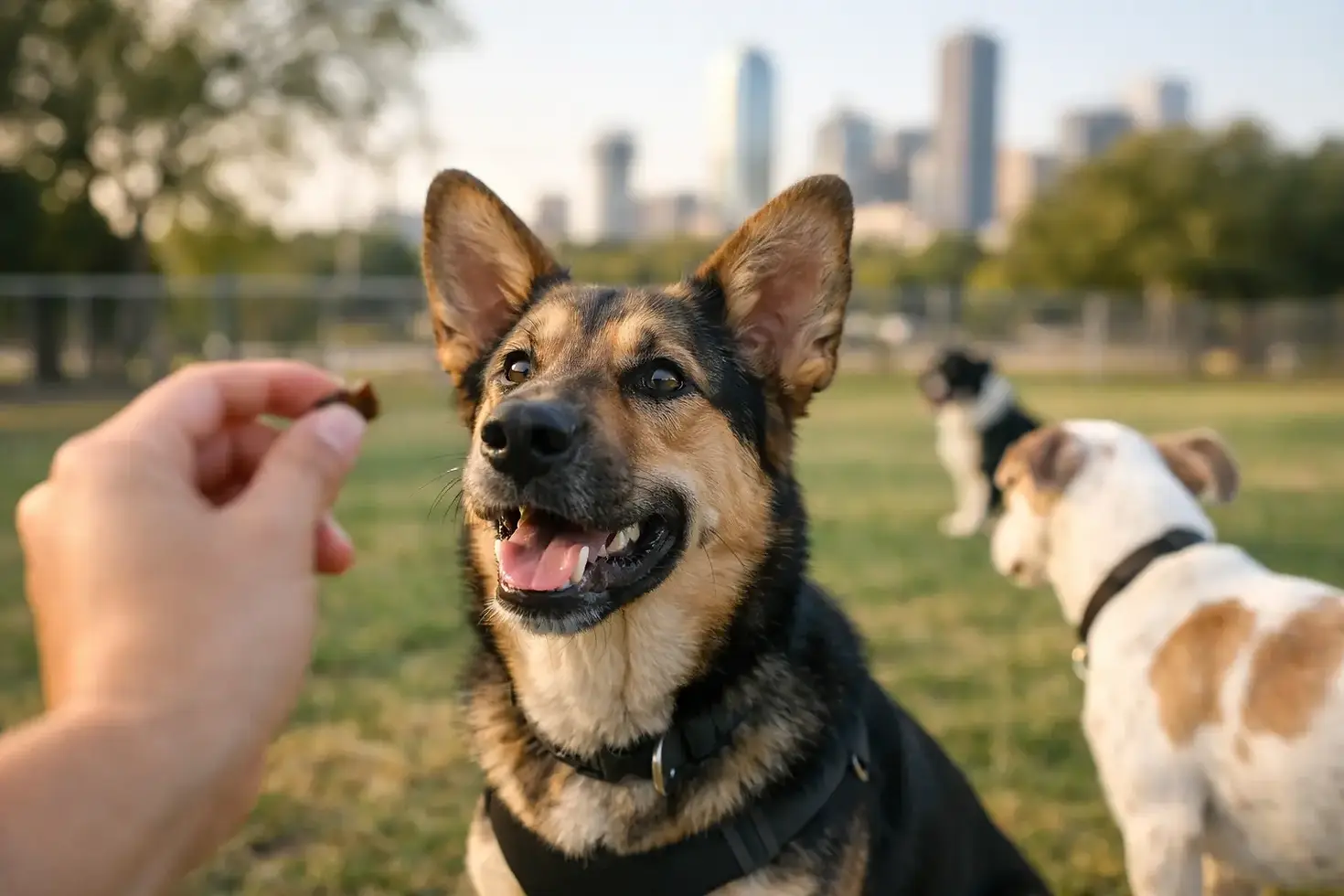
Positive Reinforcement Dog Training for Reactive Dogs

A dog who barks, lunges, freezes, growls, or spins at the end of the leash is not giving you a hard time. They may be having a hard time. Positive reinforcement dog training for reactive dogs begins there: with curiosity about what your dog is feeling and a practical plan for helping them feel safer.
Reactivity can make everyday life feel small. You may scan the sidewalk before every walk, avoid visitors, or feel your stomach drop when another dog appears around a corner. Those feelings are real, and you are not alone. With thoughtful management, well-timed rewards, and enough space, many reactive dogs can learn new ways to cope.
What reactivity is really communicating
Reactivity is a big response to something in a dog’s environment. That something might be another dog, a person, a skateboard, a delivery truck, a child running past, or even the sound of someone at the door. The outward behavior can look intense, but the reason behind it varies.
Some dogs are worried and trying to make a scary thing go away. Some are frustrated because they desperately want to get closer. Others are over-aroused, tired, in pain, or already carrying stress from a busy day. A dog can also react for more than one reason, depending on the situation.
This is why a simple label such as “aggressive” rarely gives a family enough useful information. Watch the whole picture: what happened just before the response, how far away the trigger was, whether your dog could eat, and how quickly they recovered afterward. Those details help shape a kind, effective training plan.
Why positive reinforcement dog training for reactive dogs works
Positive reinforcement means adding something your dog values after a behavior you want to see more often. Often that is food, but it can also be distance from a trigger, access to sniffing, a toy, praise, or a chance to move away.
For reactive dogs, the goal is not to bribe them through an overwhelming moment. It is to create learning experiences that are small enough for the dog to process. When your dog sees another dog at a comfortable distance, then looks back at you and receives a treat, they begin practicing a different pattern: notice, check in, feel safe.
Over time, treats can also help change an emotional association. A distant dog appearing may start to predict chicken rather than panic. That does not mean food erases fear on command. It means your dog gets repeated evidence that triggers can occur without something bad happening.
Punishment may suppress barking or lunging in the moment, but it can add discomfort to an already difficult situation. If a worried dog sees another dog and then experiences a harsh correction, the other dog may become an even stronger predictor of trouble. Force-free training protects both the relationship and the information your dog is giving you.
Start with distance, not a command
Distance is one of the most valuable tools in reactive-dog training. Every dog has a point where they can notice a trigger and still think, eat, and respond. Trainers often call this being under threshold. Once your dog is staring, barking, lunging, or unable to take food, the situation is probably too hard for learning right then.
On a walk, that may mean crossing the street early, stepping behind a parked car, turning down a driveway, or cheerfully making a U-turn. At home, it may mean using window film, a baby gate, or a quiet room when guests arrive. Management is not avoiding training. It is the safety net that prevents your dog from rehearsing reactions while you build skills.
Choose high-value treats that are easy to eat quickly, such as small pieces of chicken, cheese, or a favorite soft training treat. When your dog notices a trigger at a workable distance, mark that moment with a calm “yes” or a click, then feed. You are not asking for a long sit or perfect eye contact. At first, simply seeing the trigger and staying regulated is enough.
If your dog looks at the trigger and then looks back at you, feed again. If they need to sniff the grass or move farther away, honor that information. Training is a conversation, not a test.
Build simple skills away from triggers
Practice your helpful cues where life is easy before expecting them on a busy sidewalk. A hand target, a cheerful U-turn, a “find it” treat scatter, and moving beside you for a few steps can all become useful tools.
Treat scatters are especially handy when a surprise appears. Toss several treats into the grass and let your dog sniff them out while you create distance. Sniffing is not a cure for reactivity, but it can give your dog a constructive task and buy both of you a moment to reset.
Keep sessions short. Five successful minutes in a quiet neighborhood can be far more valuable than a long walk that leaves everyone overwhelmed. For families in Dallas, Frisco, Plano, and across North Dallas, early mornings, quieter side streets, and open spaces can make practice more manageable than crowded paths at peak times.
Read the signs before the explosion
Reactive behavior usually has a buildup. Your dog may close their mouth, become still, stare, lean forward, speed up, tuck their tail, pin their ears, or stop taking treats. These are useful signals, not failures.
When you notice them, increase distance before your dog feels they must bark or lunge. This is where learning dog body language becomes such a gift. You do not have to wait for a dramatic reaction to make a supportive choice.
Also consider your dog’s stress load. A dog who handled a visitor well in the morning may have less patience for a dog walking by the window that evening. Poor sleep, a noisy household, a grooming appointment, a vet visit, and a busy weekend can all lower a dog’s ability to cope. On those days, choose the easier route and ask less.
Set goals that make room for progress
A successful outcome is not always walking within a few feet of another dog. For one dog, progress may be eating treats while a dog is across the street. For another, it may be recovering in 30 seconds instead of 10 minutes. For a family, it may be having a plan that makes walks feel less stressful.
Avoid forced greetings, even if your dog sometimes seems social. Many dogs do better when they can observe from a distance and keep moving. Permission to say no is part of emotional safety.
If your dog has a bite history, is reacting intensely, cannot recover after triggers, or has changed suddenly, seek help promptly. A veterinarian can rule out pain or medical contributors, and a qualified force-free professional can build a plan tailored to your dog and household. Safety comes first: use secure equipment, prevent close encounters, and do not place your dog in situations they cannot handle.
If walks, visitors, or neighborhood triggers are making life feel difficult, consider scheduling a free phone consultation with Wiggle Butt Academy. A personalized conversation can help you sort through what you are seeing and choose a realistic next step.
TL;DR
Reactive behavior is often a dog’s response to fear, frustration, or overload, not a character flaw. Positive reinforcement works best when paired with distance, prevention, careful observation, and practice below your dog’s threshold. Small, repeatable wins build confidence for both ends of the leash.
Quick Tips
Create distance early when your dog notices a trigger and begins to tense.
Reward calm noticing, checking in, sniffing, and choosing to move away.
Practice U-turns and treat scatters in easy places before you need them.
Keep walks and training sessions short enough that your dog can succeed.
Get veterinary and qualified force-free support for bite risk, sudden changes, or severe reactions.
Thank you for spending time with the Wiggle Butt Library. The care you are showing by learning your dog’s signals can make their world feel safer, one small moment at a time.


Comments